
What Parents Need to Know About Pesticides and GMOs For Kids

When you hear the words “pesticide,” “GMO,” or “glyphosate,” what comes up for you? Concern? Confusion? Maybe a little guilt about whether you’re buying the “right” foods for your family?

This blog post was written in partnership with CropLife Canada. All opinions, as always, are my own.
As a dietitian and mom of three, I get it. Parents are already carrying so much mental load when it comes to feeding their kids. Add in scary headlines, conflicting social media posts, and food labels that seem designed to make you second-guess yourself, and grocery shopping can start to feel way more complicated than it needs to be.
Here’s the reassuring truth: both organic and conventionally grown foods in Canada can be safe, nutritious choices for your family. You do not need to pay a premium for organic or non-GMO labels to feed your kids well.
In this blog I have pulled together all of the facts that you need to make informed and confident decisions about how to feed your kids when it comes to GMO foods, pesticides and choosing organic or non-organic options. Read on!

What are pesticides, and why do farmers use them?
This is where I get to geek out a bit on the science! Pesticides are tools farmers use to protect crops from things that can damage them, such as weeds, insects, fungi, and disease.
Different types of pesticides have different jobs:
- Herbicides control weeds
- Insecticides protect crops from insects
- Fungicides help prevent fungal disease
These tools help farmers protect the food they grow and reduce crop losses. That matters because without crop protection tools, many fruits and vegetables would be much harder and more expensive to grow in Canada.
A 2024 economic analysis estimated that without crop-protection products, Canadian fruit and vegetable farmers could lose more than $1 billion in revenue. Some crops would likely see losses of more than 50%. That’s HUGE! Not only for farmers, but also for families. When farmers grow less food, we may see less Canadian produce and higher prices at the grocery store.
That doesn’t mean farmers use pesticides casually or without rules. In Canada, pesticides must go through a strict regulatory review before farmers can use them. Health Canada evaluates potential effects on human health and the environment before approving any use.
It’s also important to know that both organic and conventional farmers may use pesticides. Organic farming doesn’t mean “pesticide-free”. Instead, organic standards limit farmers to certain approved substances and practices.
So the difference is not “organic equals no pesticides” and “conventional equals pesticides.” Both systems use different tools to protect crops. And despite how it may sound online, “pesticide” isn’t automatically a bad word. The goal is to protect crops and provide enough food to feed our growing population while keeping risks to people and the environment as low as possible.
What is glyphosate?
This is where I think a lot of the confusion and misinformation around our food supply starts to creep in. Glyphosate is a commonly used herbicide that farmers use to manage weeds. And while that might sound a little scary at first, weeds are more than just an annoyance…they compete with crops for sunlight, water, space, and nutrients, which can make it harder to grow food efficiently.
Glyphosate blocks an enzyme pathway that plants need to grow. Humans and animals do not have this pathway.

What do pesticide residues on food actually mean?
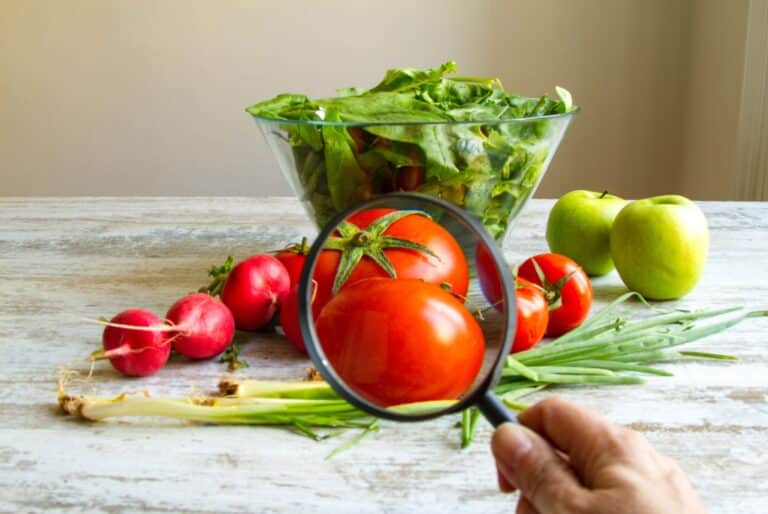
The word “residue” can sound scary (or even “dirty”) but finding a residue does not automatically mean a food is unsafe.
Today’s testing is incredibly sensitive. Scientists can detect tiny traces of substances—think of something as small as a drop of water in an Olympic-sized swimming pool!
So the most useful question is not simply, “Did testing find a residue?” The better question is, “Was the amount high enough to cause harm?”
In Canada, Health Canada sets strict limits for how much pesticide residue may remain on food when farmers use a product as directed. These limits sit well below levels that could cause harm and are designed to protect everyone, including children.
The same rules apply to food grown in Canada and food imported from other countries. In fact, more than 99% of Canadian-grown and imported produce tests well below Canada’s residue limits.
The Canadian Food Inspection Agency regularly checks food to make sure it meets these standards. So even when testing finds a tiny trace, that does not mean the amount is dangerous.
What about the Dirty Dozen list?
You may have seen the annual Dirty Dozen list and wondered whether you should avoid certain fruits and vegetables unless you can buy organic. That list does not tell parents whether normal amounts of those foods are unsafe. It ranks produce using its own scoring system, which can make trace residues sound more concerning than they actually are.
I break down what that list measures, what it leaves out, and why it can be misleading in my post on whether parents should worry about the Dirty Dozen list.
So, when we talk about pesticide safety for kids, the amount matters. That brings us to the next question parents often have: what does it actually mean when testing finds a pesticide residue on food?

Should I be worried about pesticides and my child’s health?
It’s completely understandable to have questions about this. The reassuring answer is that Canada has a detailed safety review process in place before farmers can use a pesticide. Health Canada looks at how much people may actually encounter through food and builds in extra safety margins to protect children and other vulnerable groups.
Glyphosate is one example. It is one of the most extensively studied pesticides, and Health Canada has concluded that it does not pose a risk to human health when used according to label directions.
This is also one of those topics where social media can get really loud, really fast. Scary headlines and viral posts do not always tell the full story. When it comes to food safety, I always come back to the quality of the evidence, the actual level of exposure, and what trusted health and scientific bodies are saying.
One reason for the confusion is the difference between hazard and risk.
Hazard vs. risk: A hazard is something that could cause harm. Risk considers how much of it you are actually exposed to and how likely it is to harm you.
For example, the International Agency for Research on Cancer classifies glyphosate as a “probable carcinogen.” But glyphosate shares that category with things like drinking very hot beverages and working night shifts. That does not mean they all carry the same level of risk.
The classification asks whether something could cause cancer under certain circumstances. It does not tell us how likely that is at the amount people typically encounter. Health Canada also considers real-life exposure, including how much people may be exposed to it through food.

What are GMOs?
GMOs, or genetically modified organisms, are crops created using a method called genetic engineering. This allows scientists to add or change a specific gene so the crop has a useful trait.
For example, that trait may help a crop:
- resist pests or disease
- tolerate drought
- reduce food waste
- improve nutrition
- grow more efficiently
GMOs are just one of many ways farmers and scientists improve crops. People have been selectively breeding plants for thousands of years. Genetic engineering allows scientists to make a specific change more precisely and often much faster.
Which GMO crops grow in Canada?
GM crops grown in Canada include:
- canola
- corn
- soybeans
- sugar beets
- alfalfa
In other parts of the world, farmers also grow GM crops such as papaya, eggplant, pineapple, potatoes, tomatoes, rice and squash. Farmers have grown GM crops here for nearly 30 years!

Do GMOs cause cancer, autism, allergies, or other illnesses?
There is no evidence that approved GMO foods cause cancer, autism, allergies, or other illnesses in children. These claims circulate widely online because they sound alarming. But scary claims are not the same thing as strong evidence.
Food companies also know that parents worry about this topic, which is why “non-GMO” labels can show up on products where no GMO version even exists. For example, you may see a “non-GMO” label on orange juice, even though there are no genetically modified oranges. In that situation, the label functions more as marketing than as meaningful safety information. No wonder buying groceries can be confusing as a parent!
What do non-GMO labels actually mean?
In Canada, GMO labelling is required when a change affects a food’s nutrition or safety. It is not required simply because genetic engineering was used. All “non-GMO” labels are voluntary marketing certifications.
There is nothing wrong with choosing a non-GMO product if that matters to you. But it does not automatically make the food safer, healthier, more nutritious or higher quality.
Sometimes it simply means the product carries an extra marketing label, and you may pay more for it. For a deeper dive, Canadian Food Focus has a helpful explanation of what “non-GMO” on a food label actually means.

Are GMO foods safe for kids?
Yes. Health Canada reviews genetically modified foods before they enter the Canadian food supply. Approved GM foods are considered just as safe as comparable non-GM foods. Before approval, experts assess their safety, nutrition and potential to cause allergic reactions.
It’s also worth remembering that “genetically modified” does not mean toxic or unsafe. The purpose of plant breeding, whether traditional or modern, is to help create crops with traits that are useful to farmers, the environment, and our families.
Organic or conventional: do parents need to choose the “right” one?
Nope. Many parents feel pressure to buy organic because they believe it is the safer or more nutritious choice. But both organic and conventional foods in Canada can be safe and nourishing. Here’s what’s important to know:
| Organic | Conventional | What they share |
| May use approved naturally derived pesticides and fertilizers | May use synthetic or naturally derived pesticides and fertilizers | Must meet Canadian safety standards |
| Does not use genetically engineered seeds under Canadian organic standards | May use genetic engineering | Must meet Canadian safety standards |
| Often costs more | Usually costs less | Nutrition is generally very similar |
I want you to know this: you do not have to choose between your grocery budget and good nutrition. If buying conventional produce helps your family afford more fruits and vegetables each week, that is a win.
Is organic produce more nutritious?
Okay, but what about nutrition? Here’s the truth…organic and conventional foods have very similar nutritional value. Honestly, the bigger nutrition question is not whether your apple is organic. It’s whether your family has access to nutritious foods they enjoy and will actually eat.
Should I wash fruits and vegetables?
Yes. Wash produce under running water before eating or serving it. Washing helps remove dirt and bacteria. You do not need to remove every trace of residue for produce to be safe.

How does plant science support our food supply?
Plant science includes the tools farmers and scientists use to protect and improve crops. These innovations can help farmers:
- protect crops from pests and disease
- reduce crop losses
- help crops handle changing weather
- keep Canadian food more available and affordable
A 2024 economic analysis estimated that Canada would have produced $14.6 billion less in crops without crop protection and modern plant breeding. The same report found that relying only on organic production would likely raise food costs by up to $6,665 per year for the average household. The takeaway? These tools help farmers protect crops and keep food more available and affordable. We love that!
These tools also support local production. Without crop protection, some fruits and vegetables would be less economical to grow in Canada, which could mean relying more heavily on imports.
What should parents focus on at the grocery store?
When grocery shopping starts to feel overwhelming, I like to bring it back to the basics. Ask yourself:
- Does your family enjoy it? Food should be satisfying and enjoyable. Buy foods your family actually likes and will eat.
- Is it affordable? Choose options that work for your budget. Compare fresh, frozen, canned, store-brand, and name-brand foods.
- Is it accessible and convenient? Frozen, canned, dried, and fresh foods can all be nutritious. There is zero shame in choosing convenience foods that make family life easier.
- Does it add variety? Offering different foods over time helps provide a range of nutrients and keeps meals interesting.
For more practical tips, read my guide to grocery shopping for kids.
The bottom line on pesticides and GMOs for kids
Pesticides, glyphosate, and GMOs can sound intimidating, especially when social media strips away context. But here’s what I want parents to remember:
- Canada regulates pesticides and food residues using safety standards designed to protect people, including children.
- Approved GM foods are as safe and nutritious as comparable non-GM foods.
- Both organic and conventional foods can be safe, nourishing choices.
- Eating a variety of fruits and vegetables matters more than how they were grown.
Choose foods your family enjoys. Choose what fits your budget. Choose what is accessible. And please don’t let fear-based food messaging convince you that conventional produce is dirty, dangerous, or second-best.

Sarah Remmer, RD, is a registered dietitian and mom of three, specializing in family and pediatric nutrition. She’s the founder of Centred Nutrition Collective and has nearly 20 years of experience helping families feel confident about feeding their kids.
This post may contain affiliate links. View our policy.


Thank you for this informative post on pesticides and GMOs and their potential impact on kids’ health. As a parent, I’m always concerned about making sure my kids are eating foods that are both safe and nutritious, and it’s helpful to have a better understanding of these issues.
It’s clear that you have done your research and are passionate about helping parents make informed decisions about what they feed their families. Thanks for sharing your knowledge and insights on this important topic!