Should Parents Worry About the Dirty Dozen? A Dietitian’s Take (2026)
If the Dirty Dozen list has you feeling unsure about what to buy in the produce aisle, you’re definitely not alone. Every year, this list makes the rounds online, and suddenly parents are flooded with scary headlines about pesticide residues on produce, and grocery shopping becomes more stressful (as if parents don’t already feel enough pressure when it comes to feeding their families).

Conventional strawberries are “bad.” Spinach is “dirty.” Apples are questionable, especially with the skin on….Oh, and the Dirty Dozen list is updated every year, so you wrap your head around the current list, only to have it switched up the following year. No, thank you!
Before you panic, here’s what I want you to know first
As a dietitian and mom of three, I want to ease your mind right away – all fruits and veggies are nourishing and good, whether they’re organic or not. Conventional produce is not bad, harmful, dirty or dangerous. It’s full of fibre, vitamins, minerals and important nutrients that kids need. Choosing to buy organic is a personal choice and a-okay, but from a nutrition or safety point of view, there’s really no difference between organic or conventional.
Let me put it this way…when fruits and veggies (or really any food) are villainized in any way online, it should raise a red flag. But of course, if something makes it sound like the fruits and vegetables you’re putting in your cart might be harmful, of course, that gets your attention. You’re also human! But before you swear off strawberries or start feeling like you need to buy only organic produce forevermore, it helps to understand what the Dirty Dozen list is actually measuring…and what it isn’t.
What the Dirty Dozen list actually measures
What’s important to understand is this: the list may sound like it shows which fruits and vegetables are the most dangerous, but that’s not what it actually measures. The Environmental Working Group (EWG) ranks produce based on how many pesticide residues show up in U.S. Department of Agriculture (USDA) testing, not on Canadian health-risk standards or actual risk to your health. It also doesn’t account for how much of a food people typically eat or whether the amount present is high enough to cause ANY harm. The truth is that when pesticide residues show up on produce, they are typically at levels far too low to pose a health risk to consumers.
Unfortunately, this list is misleading, causes unnecessary fear mongering and spreads misinformation, which really gets me riled up as a dietitian whose job it is to help parents feel less stressed and more empowered when it comes to feeding their children.
So before we let a scary list shape what goes into our grocery cart, let’s take a closer look at what the Dirty Dozen actually is and why it can be so misleading.
What is the Dirty Dozen list?
The Dirty Dozen is part of the EWG’s annual Shopper’s Guide to Pesticides in Produce. Each year, the EWG looks at pesticide residue data from the USDA and ranks produce items based on which residues show up and how many are present. They analyze 47 produce items and highlight 12 as the “most contaminated,” with green beans and peppers also flagged in 2026 because the EWG says they ranked high on overall pesticide toxicity.
Honestly? It’s not hard to see why the list gets so much attention.
The name is catchy. It taps right into parents’ fears about doing the wrong thing. And it often gets shared without much context. That’s where things can start to go sideways.
Here’s the big problem: Pesticide residue does not automatically mean risk
This is really the heart of the issue. The Dirty Dozen ranks produce based on detected pesticide residues and the EWG’s scoring system. But detection is not the same thing as harm.
Scientists can now detect very, very small amounts of substances on food. So the question is not simply, “Was something detected?”
The more important question is, “Was it detected at a level that could actually harm health?” That distinction matters a lot, my friends!
You may have heard the phrase “the dose makes the poison.” It simply means that whether something is harmful depends on how much of it you’re exposed to. Even water can be dangerous in excessive amounts. It’s the dose that matters.
And modern testing technology is incredibly sensitive. We’re talking tiny traces here. Sometimes we’re measuring in parts per billion, which is an unbelievably small amount. A helpful visual? That can be like a teeny drop of water in an Olympic-sized swimming pool.
So yes, scientists can detect tiny residues. But tiny residues don’t equal a meaningful health concern.
What the Dirty Dozen list leaves out
This is where the Dirty Dozen can become really misleading for families. For starters, it does not tell parents whether eating normal amounts of these fruits and vegetables is unsafe. It simply tells you that residues were detected and then ranks produce according to the EWG’s own system.
It also does not reflect how Canadian food safety standards work.
Detection is not the same as danger
Here’s the more technical explanation, which is important. The EWG uses “toxicity” more like a general hazard label, while Health Canada looks at actual risk. In other words, the EWG focuses mainly on whether a pesticide could cause harm under certain conditions. It doesn’t fully consider how much of it people actually consume through food. Health Canada takes a more complete approach. It looks at real-life exposure, including
- how much people eat,
- how much pesticide remains on the food,
- how it breaks down over time,
- built-in safety margins, and
- whether exposure stays far below harmful levels.
In plain language? The EWG’s list makes pesticide residues sound scary because they imply any hint of residue is dangerous, when that’s not the case. Meanwhile, Health Canada asks a more helpful and practical question:
In real life, are people actually being exposed to high enough levels of pesticides to cause harm?
And the answer to all produce is a big NO. Again, all produce is good produce. Purchase fruits and veggies that are within your budget (whether organic or conventional, fresh or frozen) and that you can easily access, period.
Health Canada looks at the full picture
It’s also important to understand this: the EWG collapses a complex regulatory decision into a single score, ignoring built-in safeguards. Health Canada’s approvals consider hundreds of studies, vulnerable groups (like children and pregnant people), cumulative exposure, and ongoing re-evaluations as new science emerges. The EWG’s approach simplifies this into a ranking that can make residues well within Canadian safety limits appear equally concerning, without reflecting how rigorously those limits were set or enforced.
In other words, the list flattens a very nuanced, science-based process into a headline-friendly ranking. That may grab attention, but it doesn’t actually help families understand risk in a meaningful way.
Real-world exposure matters
The EWG also points out that people can be exposed to more than one pesticide at a time. But Health Canada already takes that into account. It looks at the total amount of similar pesticides a person could be exposed to through food and everyday life, especially when those pesticides affect the body in similar ways. Then it adds extra safety margins to help make sure the food supply is safe for everyone, including kids and other more vulnerable groups.
That’s a lot of technical language…but here’s the reassuring takeaway: regulators look at overall pesticide exposure from many sources and build in extra safety buffers, especially for kids and other vulnerable populations.
The PFAS piece needs context too
This year, the EWG also mentions PFAS pesticides (per- and polyfluoroalkyl substances) specifically and frames them as a new health concern. PFAS are a group of man-made chemicals sometimes called “forever chemicals” because many of them break down very slowly in the environment. Manufacturers have used them in lots of products over the years because they resist water, grease, and heat.
But again, the context matters. The EWG largely skips over how tiny these residue levels are and how regulators evaluate whether those trace amounts actually matter for people’s health. This can make it sound like the presence of a PFAS-classified pesticide automatically means danger, even when exposures are measured in extremely small amounts. Again, super misleading.
And here’s the important part that often gets left out: What the EWG does not take into account is that in Canada, PFAS-type pesticides are reviewed under a science-based system that looks at real-world exposure, cumulative effects, and large safety margins before anything is allowed on food. Health Canada only permits uses that keep total exposure far below levels shown to cause harm, so calling out PFAS residues without that context can create anxiety that doesn’t reflect how safe Canada’s regulated food supply actually is.
Why this matters for families
The biggest problem with fear-based food messaging is that it doesn’t just create confusion. It can change behaviour in ways that aren’t actually helpful. It can make grocery shopping much more stressful, and it can add guilt to choices already shaped by budget, access, energy, picky eating, and the realities of family life. In some cases, it can even discourage families from buying certain fruits and vegetables altogether, which is the bigger health concern.
That, in my opinion, is the much bigger issue. Most Canadians are not eating enough fruits and vegetables to begin with. So if a parent decides not to buy strawberries, spinach, apples, or grapes because a scary list made them feel unsafe, that’s not a public health win.
I would much rather see families buying and serving produce regularly, whether it’s organic or conventional, than avoiding it based on misinformation online.
What parents should know about pesticide residues in real life
Canada has legal limits for how much pesticide residue may remain on food when pesticides are used as directed. These are called maximum residue limits.
Health Canada says these limits are set well below harmful levels and account for vulnerable groups, including children. All food sold in Canada, whether produced here or imported, must meet these requirements.
That doesn’t mean there are never residues. It means that when residues are present, they are regulated within a system that is designed with safety in mind. If you want the fuller deep dive on how pesticide safety and regulation work, I break that down in more detail in my post on what parents need to know about pesticides and GMOs for kids.
A better way to look at this: Put the numbers in perspective
One of the most helpful tools I’ve come across is the pesticide residue calculator from the Alliance for Food and Farming. It uses a “worst-case scenario” based on the highest pesticide residue recorded by USDA testing data for each produce item. In other words, it is not sugar-coating anything. It’s using the highest level ever recorded and asking: how much would someone actually have to eat before there was a concern?
And the answer is often: a wildly unrealistic amount.
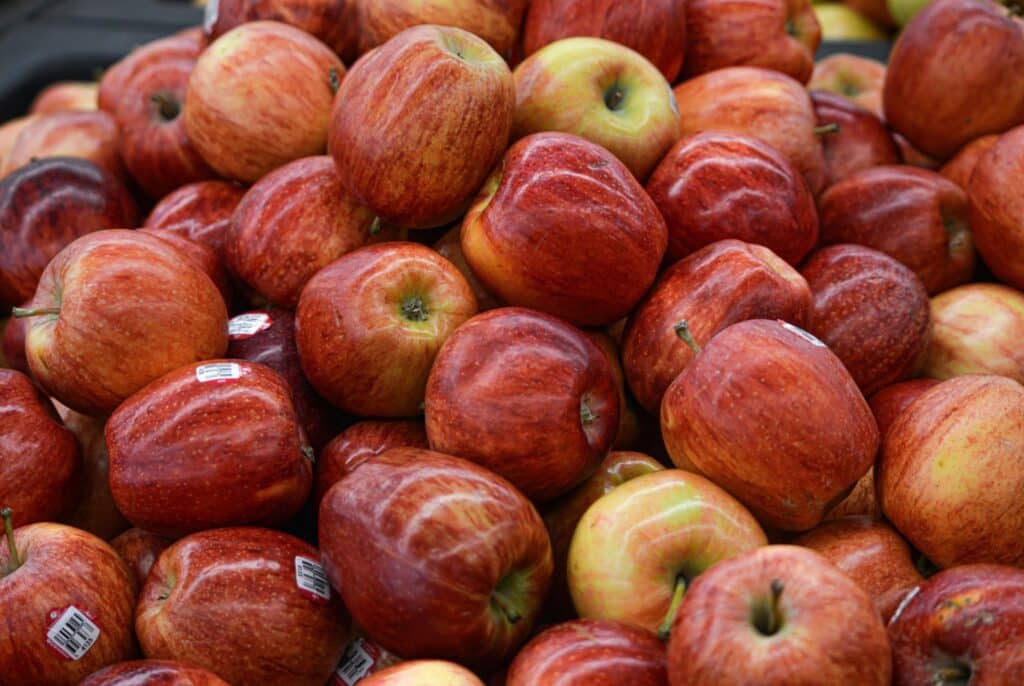
According to the calculator FAQ, a person would need to eat hundreds to thousands of servings in a day for residues to approach levels of concern. For example, a child could eat about 300 apples in a day without any effect, even if the apples contained the highest residue levels recorded by USDA monitoring data. Yup, three hundred apples.
That doesn’t mean we ignore food safety. It means we stop and ask whether the scary message actually reflects real-world risk. Usually, it doesn’t.
If you want to play around with the numbers yourself, you can check out the pesticide residue calculator here. I think tools like this are much more helpful than a dramatic ranked list because they actually give parents perspective.
What about organic produce?
Let me be clear: this post is not about telling families they should or should not buy organic.
Buying organic is a personal choice. If organic produce fits your budget, access, preferences, or values, that is absolutely okay. If conventional produce is what works best for your family, that is okay too.
It’s also worth remembering that both organic and conventional can use pesticides. The difference is not as simple as “organic means pesticide-free” and “conventional means unsafe.” That’s just not how food production works.
The main takeaway here is not that organic is bad or unnecessary. It’s that conventional produce should not be feared. If you want a fuller conversation about organic versus conventional food, you can read more in my post on pesticides and GMOs for kids.

What I want parents to focus on instead
Instead of getting stuck in scary lists and headlines, here’s what I’d love parents to focus on:
- Serve fruits and vegetables regularly.
- Choose what works for your budget, access, and family preferences.
- Don’t let fear override the bigger picture.
So, I’ll leave you with a few practical reminders that you likely already do:
- Rinse produce under running water before eating or serving it
- Buy the fruits and vegetables your family will actually eat, whether they’re organic or conventionally grown
- Aim for variety, not perfection
That’s it.
Bottom line
The Dirty Dozen list makes shopping for your family feel more complicated (and scary!) than it needs to be. But the most important thing is still the most basic thing: keep offering a variety of fruits and vegetables to your kids.
Organic or conventional, washed and ready to eat is almost always better than produce left behind because a scary headline got in the way. What parents need is context, not more fear.

Sarah Remmer, RD, is a registered dietitian and mom of three, specializing in family and pediatric nutrition. She’s the founder of Centred Nutrition Collective and has nearly 20 years of experience helping families feel confident about feeding their kids.
This post may contain affiliate links. View our policy.